 Tweet
Tweet
Yeah I know it sounds like something too impossible to believe for some, but I finally found something that could be seen as an upgrade to a Mopar, by using a Ford part... 
I've been annoyed for some time now by the fact that the average '60/70's Mopar alternator stops charging when engine rpm's drop below 600 rpm orso.
Since my engine runs on LPG, I got it idling around 500 in drive/550 neutral.
During evening drives, at pretty much at every stopsign the ALT-gauge in the car pegs to almost full discharge. Even more if rains and fan is on.
To solve this issue (since I don't want to increase the idle-rpms), I wanted to try out a modern alternator and see if these things DO charge at lower rpm's.
So a friend got me a 90's Ford "3G" alternator to try out. I ordered an electrical connector for it to complete it's 'internal' wiring.
Another issue was the 3G alternator used a serpentine pulley, while my car still has v-belts.
I decided to make a double row v-belt pulley on my lathe, with a slightly smaller diameter than the smallest pulley I already had in my stash.
Mounted the alternator under the hood with a simple curved strip of aluminium, and also decided to run the headlights through a relay, to keep the lightswitch from frying out.
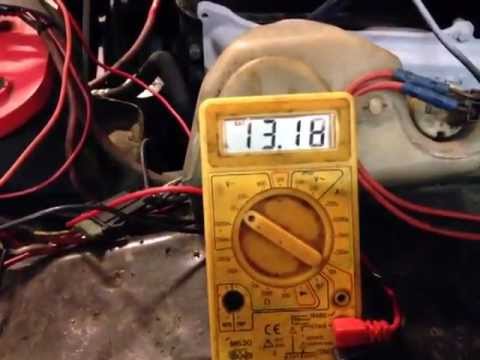
After everything was connected again I measured the voltage delivered by the alt, and it was still charging, even with the engine in Drive, lights and defrost-blower-fan on...
I've been annoyed for some time now by the fact that the average '60/70's Mopar alternator stops charging when engine rpm's drop below 600 rpm orso.
Since my engine runs on LPG, I got it idling around 500 in drive/550 neutral.
During evening drives, at pretty much at every stopsign the ALT-gauge in the car pegs to almost full discharge. Even more if rains and fan is on.
To solve this issue (since I don't want to increase the idle-rpms), I wanted to try out a modern alternator and see if these things DO charge at lower rpm's.
So a friend got me a 90's Ford "3G" alternator to try out. I ordered an electrical connector for it to complete it's 'internal' wiring.
Another issue was the 3G alternator used a serpentine pulley, while my car still has v-belts.
I decided to make a double row v-belt pulley on my lathe, with a slightly smaller diameter than the smallest pulley I already had in my stash.
Mounted the alternator under the hood with a simple curved strip of aluminium, and also decided to run the headlights through a relay, to keep the lightswitch from frying out.
After everything was connected again I measured the voltage delivered by the alt, and it was still charging, even with the engine in Drive, lights and defrost-blower-fan on...
Attached Files


Comment