













We know that this story has been floating around the internet for months, and we have not idea who originally wrote the text, but we think it’s just too damn cool. If you are the dude that wrote this, good job Jack. Read this story, check out the photos, and enjoy the hell out of some good old fashioned ingenuity.
Until the early 1960s, automobiles moved by rail were carried in boxcars. These were 50 feet long with double-wide doors. Inside was room for four full-sized sedans on a two-tier rack – two raised up off the floor on a steel rack and two others tucked in underneath them. This protected the cars during transport but wasn’t very efficient, as the weight of four vehicles was far less than the maximum weight a boxcar that size could carry. When 85-foot and 89-foot flatcars came into service, it was possible to pack a total of fifteen automobiles in one car on tri-level auto racks. But it still didn’t approach the maximum allowable weight for each flatcar.
When Chevrolet started designing Vega during the late 1960s, one of the main objectives was to keep the cost of the car down around $2,000 in circa-1970 dollars. At the time, the freight charge for moving a loaded railroad car from the Lordstown, OH assembly plant to the Pacific coast – the longest distance cars produced at Lordstown would need to travel – was around $4,800. Since the Vega was a subcompact, it was possible to squeeze three more cars on a railroad car for a total of eighteen, instead of the usual fifteen. But that still worked out to around $300 per car – a substantial surcharge for a $2000 car. If only Chevrolet could get more Vegas on a railroad car, the cost per unit of hauling them would go down.
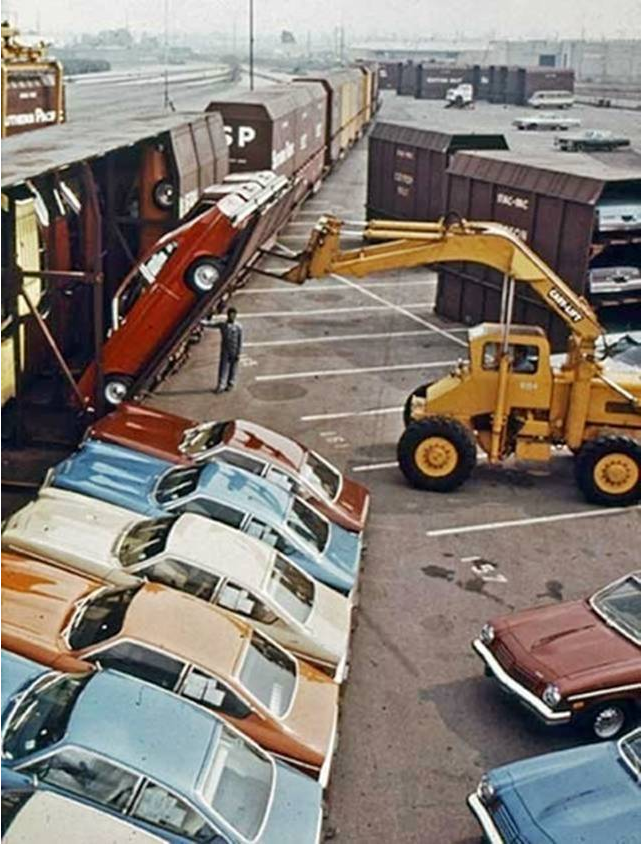
The engineers at GM and Southern Pacific Railroad came up with a clever solution. Instead of loading the cars horizontally, the Vegas were to be placed vertically on a specially designed auto-rack called the Vert-A-Pac. Within the same volume of an 89-foot flatcar, the Vert-A-Pac system could hold as many as 30 automobiles instead of 18.
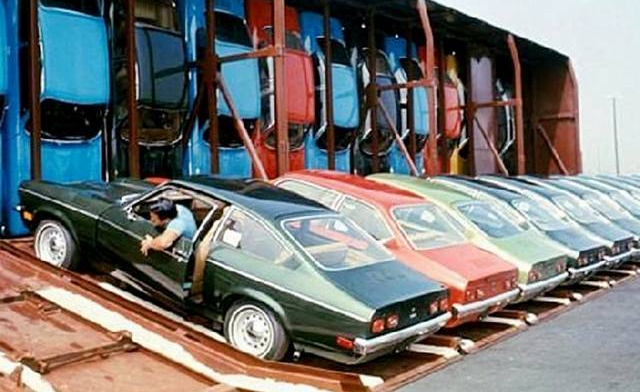
Chevrolet’s goal was to deliver Vegas topped with fluids and ready to drive to the dealership. In order to be able to travel nose-down without leaking fluids all over the railroad, Vega engineers had to design a special engine oil baffle to prevent oil from entering the No. 1 cylinder. Batteries had filler caps located high up on the rear edge of the case to prevent acid spilling, the carburetor float bowl had a special tube that drained gasoline into the vapor canister during shipment, and the windshield washer bottle stood at a 45 degree angle. Plastic spacers were wedged in beside the powertrain to prevent damage to engine and transmission mounts. The wedges were removed when cars were unloaded.
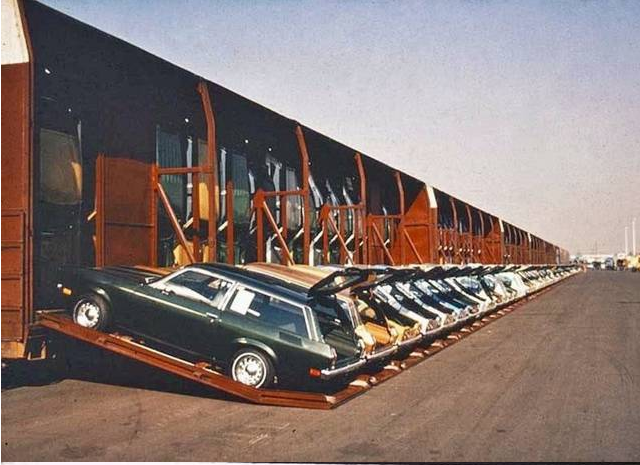
The Vega was hugely popular when it was introduced in 1970, however it quickly earned a reputation for unreliability, rust and terrible engine durability. When the Vega was discontinued in 1977, the Vert-A-Pac cars had to be retired as they were too specialized to be used with anything else. The Vert-A-Pac racks were scrapped, and the underlying flatcars went on to other uses.
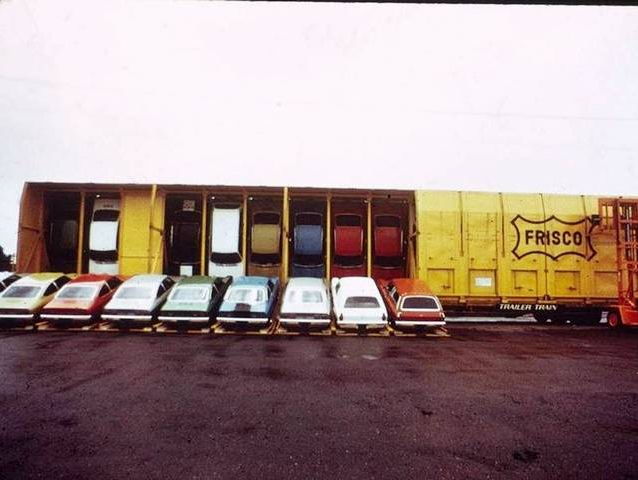
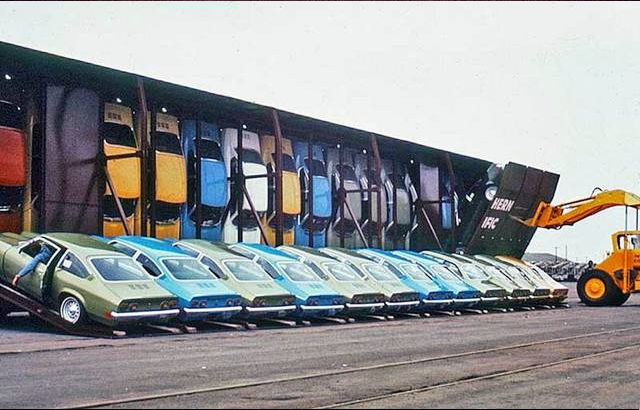


Have seen this before, but it is a great story. Ingenius, I think. Too bad the cars were so bad…I do like the styling of the original (non-slope nose) models.
I remember that from back when they were new…and wondered what happened to the racks afterward. Good pics.
They really tried to advance the auto-making process with the Vega, through and through. It used computers for design and robots for assy more than any car up ’til then. There was actually a clear plastic scale model formed up of the body which could be twisted and by the way it affected light, reveal stress points…early finite-element analysis, I guess. Still the whole process became a text-book example of what not to do…even written by people who knew nothing about cars, who was anyone to argue?
A great car off the lot but too bad about the rust, and horrible, horrible motors. GM and their cost guys effectively handed an entire generation of car buyers over to Toyota.
Vegas came alive with a SB Chev! Remember the swap kits?
Wonder if they had any fluid issues shipping them like that ?
Never mind. If I would have read the whole story it gave me the answer.
VEGA!
The Tonowanda N.Y., assembly plant allowed long hair/ponytails on the workers,then flared bell-bottom jeans, to encourage and to promote better morale for Vega assemblers.
They even turned a blind “nostril” to the ever-increasing smell of marijuana on the work floor.
Did this in part have anything to do with the off-quality (sometimes) of the Vega?
Vegas, I love ’em!
The production cars may not have been that durable. But the flat grill Vega made the all time best looking and most popular Funny Car bodies ever! We need more Vega clad nostalgia fuel Funny Cars.
i had a ’75 wagon, changed the oil every 2-3000 miles and kept it clean top and bottom and it lasted almost 100,000 miles.
my girlfriend had a ’75 hatchback and when it got about 20,000 miles i asked when was the last time she had the oil changed and she asked “you’re supposed to change the oil?” it lasted another 5k miles and crapped out.
some were good cars and some weren’t, just like every brand and model
My folks bought a brand new Vega wagon in ’73. Car made it to 30k before dad took it to the junkyard. He had to have the rusty fenders replaced only 9 months after he bought it. Last new car he bought, and did not own a Chevy until this year. Dad was a devout Mopar man for 40 years. He traded his Dodge Caliber (total POS) in on a low mile 2013 Malibu which is a nice car.
The Grump stood his back on the nose in i think July of 78 at Oswego Dragway in Illinois!! LOL
The aluminum engine block had a special hard silicon coating that was supposed prevent cylinder wear. That didnt work too well. My cousin had an engine shop and made good money installing cast iron sleeves in those engines. After that they would run forever as long as you changed the oil regularly. As for the body rust? GM coulda, shoulda did their homework. The Vega would have been a hit instead of s**t!