








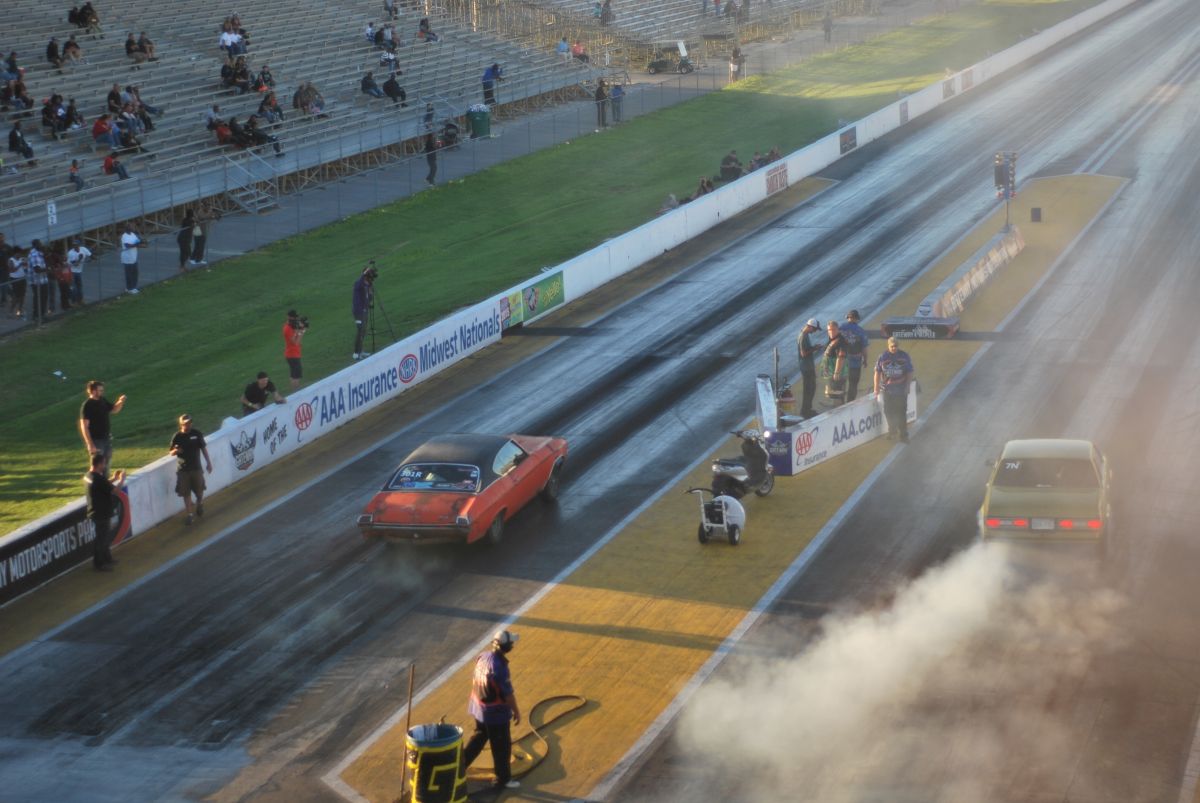
Hot Rod Magazine’s Drag Week is the most intense form of street-car racing in the world. The competition pits street cars, some of which really push the boundaries of that phrase, to run passes at four different drag strips across five days while also driving the cars on the roads between tracks. The total distance traveled is usually somewhere well north of 1,000 miles, meaning that cars capable of running 250 mph in a quarter-mile have to drive on the roads with your grandmother’s Camry.
The competition is divided up into classes to give drivers a chance to compete heads-up with similar cars and with somewhere around 400 cars shoving off from National Trail Raceway in Hebron, Ohio, today, expect a whole lot of action. You can stream the whole week live on the MotorTrend YouTube Channel with BangShift’s own commander-in-chief Brian Lohnes handling the announcing and commentary duties along with Roadkill’s David Freiburger.
Before racing gets started bright and early Monday, here is BangShift’s guide to the heavy hitters in each classes with the caveats that (A) this was prepared before Tech Day so not all entries on the unofficial entry list might show up, (B) cars from the entry list switch classes regularly from what they expect to run, and (C) there are always first-time racers and returning Drag Weekers who come out of virtually nowhere to surprise us. The classes are listed below along with the class-designation letter that will be attached to each car’s number.
UNLIMITED (A)
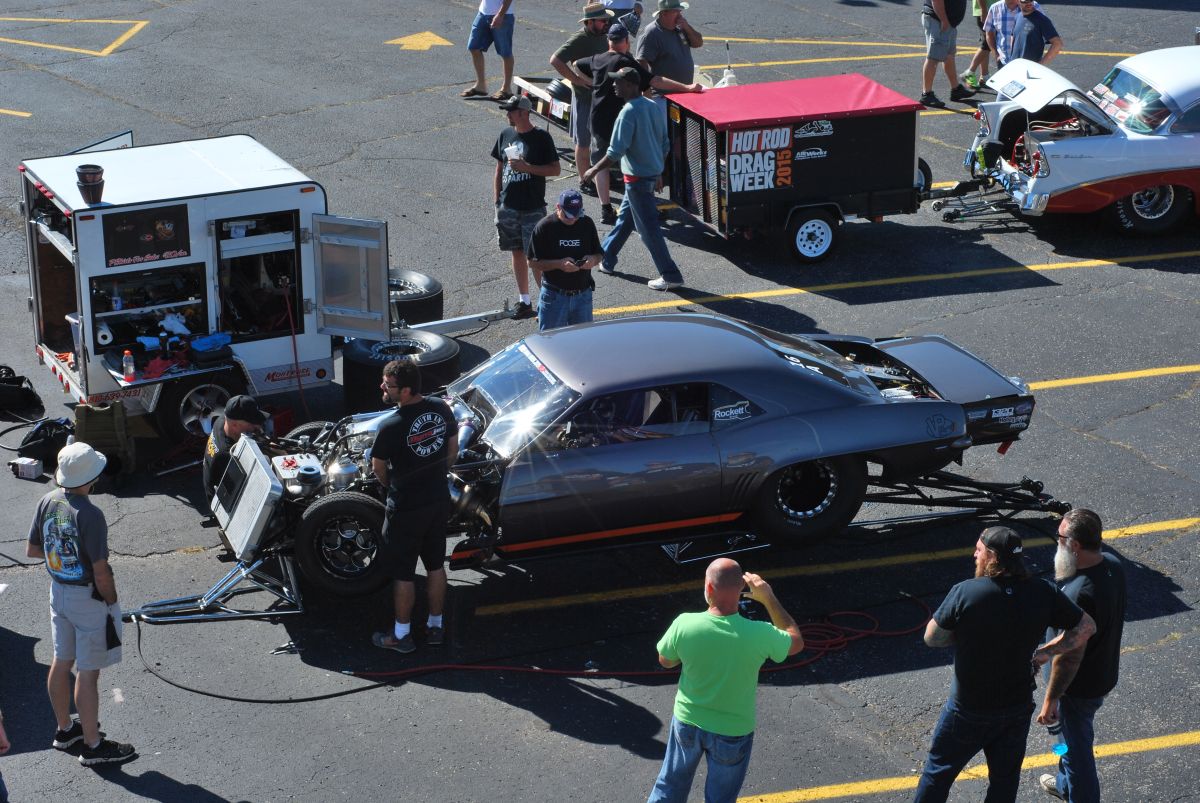
Home to the most extreme street cars on the planet, the Unlimited class has seen some remarkable feats and looks poised, as ever, to produce more jaw-dropping passes in 2016. Tom Bailey’s Sick Seconds 2.0 Pro Mod ‘69 Camaro (above) returns after his overall win last year with a new, more extreme engine. Bailey recent said he wasn’t worried about its performance at the track but said the road miles will be the real test. He’ll square off with Jeff Lutz, whose own Pro Mod ripped off the quickest and fastest pass ever at Drag Week in 2015 (6.051 seconds @ 251.95 mph), though it was the only day of racing he completed. After winning the inaugural Drag Weekend last October, Lutz’s Pro Mod looks better sorted and could produce a real show against Bailey’s Pro Mod. Will either make the first 5-second pass in Drag Week?
Elsewhere in Unlimited, a pair of stout nitrous cars could play spoiler if things go awry for the heaviest hitters. Dave Schroeder’s ‘66 Corvette with its ground-pounding 872 cubic-inch engine and three stages of nitrous has shown it’s capable of a 6-second timeslip, though reliability has continued to plague the complex beast. Mike Wenzler’s third-gen Camaro ran in the mid-7s at Drag Week 2015 to take second in Unlimited. With an 11-foot-tall hood scoop hiding the World’s Tallest Tunnel Ram, his F-Body is always fun to watch.
ULTIMATE IRON (B)
Last year, the only two competitors in the all-steel class, Bryant Goldstone and Joe Barry, finished on the overall podium at Drag Week. This is essentially the same class as Unlimited—Basically, anything goes, build as extreme as you think will stand the test—except the cars have to be built from all steel with a minimum weight. Bryant Goldstone’s twin-turbo, Big Block Chevy AMC Javelin ran only the fifth 6-second average e.t. in Drag Week history last year to finish second overall and take the class’ inaugural win. He’s back with a lighter car making more horsepower and he’s aiming for 6.60s, which could put him in striking range for an overall win. Barry unfortunately will not be competing in Drag Week 2016.
Don Foess’ turbocharged, Big Block Chevy-powered Chevette is one of the most insane cars you’ll see all week. Don’t miss this thing running because when it launches, it looks poised to send Foess into a full-body cast. Instead, it makes 7-second passes around 180 mph. Totally nutso.
PRO STREET POWER ADDER (C)
Pro Street cars are essentially back-halved cars using big tires. As will be the case with all classes below “Power Adder” refers to any kind of power-boosting device (supercharger, turbocharger, nitrous, etc.) while “Naturally Aspirated” refers to an engine that breathes without those things. The Pro Street class was exceptionally competitive last year and looks strong again this year.
Australian John Faraone is registered for the class, although if he’s running any kind of alternative fuel, he’ll have to run in one of the top two categories. If not, he’s capable of running in the mid 7-seconds and would threaten Mike Roy’s quickest Drag Week pass in Pro Street, a 7.561. Roy put his iconic Monte Carlo up for sale after failing to finish last year, which leaves defending winner Tom McGilton near the top of the heap with his Larry Larson-built Chevy Camaro ZL1, which aside from the insane horsepower and 7.857-second average last year, is otherwise a functional ZL1 down to the stock touchscreen.
In his Drag Week debut last year, Matt Blasco’s ‘72 Dart Swinger nearly crashed the Pro Street party, running as quick as 7.702 seconds and leading the class until a transmission failure ended his bid to win one of the most competitive. He returns, as does Glenn Hunter. Hunter’s ‘56 Belair wasn’t messing around with a quickest pass in 2015 of 7.633 seconds—the fourth-quickest ever in the class—and he gives another very quick option.
Keep an eye on this class. If Shawn Fink puts his 7-second ‘63 Chevy into the mix and Tina Pierce shows up with her low-8-second Chevy Colorado, it’s gonna be a helluva show in the Pro Street PA.
PRO STREET NATURALLY ASPIRATED (D)
Last year, James “Doc” McEntire made the quickest naturally aspirated pass in Drag Week with an 8.375-second rip at Indy. McEntire will sit out this year, though his old nemesis Eddie Miller will be there with a car he prepared for his daughter, Katie Miller. Miller’s purple Duster held the record before so we’ll see what his fresh build does this year.
Of the returning cars, none have run quicker than Jeff Atkinson’s ‘69 Camaro with a 9.691-second pass on the first day of Drag Week though Atkinson didn’t reach the second day of competition. Glenn Bridger finished second in the class last year with a mid-10s average.
MODIFIED POWER ADDER (E)
This is basically the same class as Pro Street except with a small tire and like the Pro Street PA class, this will be incredibly competitive. Rick Prospero’s bright-green Mazda RX-7 has a pair of turbos on its Big Block Chevy, which propelled Prospero to the class win last year. That same engine had sent his old Nova Wagon quicker than his 8.2266-second average last year, so there’s reason to think the Mazda will go quicker this year.
He might need it with Todd Maschmeier registered for Drag Week this year. Maschmeier has shared his ‘68 Camaro with Travis Gilpin and the pair have won this class three times, setting the quickest averages and nine of the 10 quickest passes ever in Modified PA.
Shane McLelland’s Crusty Nova does more than spectacular wheelstands—though it’s prone to doing those, for sure. McLelland ran 8.130 last year, though his average belied that some. Newcomer Bobby Robinson’s Chevy Luv could be in the mix, as well.
MODIFIED NATURALLY ASPIRATED (F)
Last year, the first three days of Drag Week featured a great battle between Jay Brown’s SOHC-powered ‘68 Mustang and Brad Dyer’s ‘72 Nova. Dyer’s Nova broke terminally on the third day and Brown then became the first entry in the class ever to run an 8-second average. He had hoped to log times under 9 seconds on every week, but the afternoon rainout on Day 4 at Cordova took away his chances at ithat. Dyer still should have something for Brown; he was the first to run 8 seconds in the class and won Modified NA in 2013. Brown is a three-time class winner, though, so this should be a good heads-up matchup.
Josh Norris’ bright-red Chevy II finished second last year more than a second behind Brown, but anything can happen in Drag Week. Scott Scribner’s ‘67 Camaro and Billy Gebhart’s ‘62 Valiant also had 10-second averages last year and should be in play. A half-dozen new entries could contend for the top three spots, as well.
SUPER STREET BIG BLOCK POWER ADDER (G)
The Super Street classes feature cars that are closer to stock than Modified, using stock-concept rear suspension and stock-ish bodies. In the Big Block Power Adder class, George Gallimore’s two-ton Monte Carlo is one of the most insane drag cars you’ll ever see. The personal luxury coupe launches relatively easily and then Gallimore pours the boost onto the Big Block Chevy to run passes as quick as 7.665 seconds and 192 mph. Frank Saponaro’s gorgeous wheel-standing turquoise Nova Wagon also average 7.9 seconds and will return looking clean after hitting the wall during a run in April 2016.
That duo will face some stiff competition. Jeff Bomyea (above) and his red ‘68 Camaro were second overall at Drag Weekend 2015 with a 7.797-second average. His car is well-sorted and will test Gallimore’s resolve. Scott Smith’s A-Body Malibu ran a quickest pass of 7.820 seconds in 2011 on the way to winning the class. If that’s indicative of a pace he can run all week now five years later, this suddenly becomes even more fascinating.
Proven 8-second cars from Gary Putnam (1990 Ford Mustang) and Clark Rosenstengel (2010 Chevy Camaro) along with Dennis Taylor’s very quick Nova add to the intrigue. This should be one of the absolute best classes to watch in terms of spectacle and competitiveness.
SUPER STREET BIG BLOCK NATURALLY ASPIRATED (H)
Five-time class winner Curt Johnson is registered in this class with red Ford Mustang that may or may not be the car with which he dominated the Street Race Big Block Naturally Aspirated class the last three years. Or it might not. If Johnson is in this class, expect him to be in tip-top form. Vince Rasch’s wheelstanding ‘69 Firebird won the class last year, his third class win at Drag Week. Rasch has run every Drag Week and knows the drill so if anyone is going to compete with Johnson—who is also registered with another car in a different class—it will be Rasch.
Gary Satterlee’s 1990 Mustang won this class way back in 2009 with a 10-second average. Steve Satterlee ran it a couple years later to a class win and a quickest pass of 9.876. That could fare well against Rasch’s mid-9s Firebird. Former hardware winners Randy Heinselman (1970 Plymouth Barracuda) and Frank Romano (1955 Chevy 210) also return this year.
SUPER STREET SMALL BLOCK POWER ADDER (I)
Calvin Hayward’s performance in Drag Week 2015 was nothing short of staggering. In the small tire and small block class, his bright-pink Mustang finished with the fourth-quickest average of the week. His 7.589-second pass at Indy was also the quickest-ever at Drag Week by a small-tire car. Clay Forrester’s own turbocharged Fox Mustang is a wheelstanding monster that came second to Hayward with his own 7-second average. Kurt Borton’s Fairmont Futura and James Karger’s Mustang wrap up the quartet of Fox Body favorites. However, 14 first-timers have signed up expecting to run in this class there may be more depth than we’re giving credit for here.
SUPER STREET SMALL BLOCK NATURALLY ASPIRATED (J)
Jeff Sias is two-for-two in Drag Week competition, including a win in this class last year with a 9.977-second average. His maroon Mustang should be in the mix, but Dwain Phelps’ C6 Corvette may move up from the Street Race Small Block Naturally Aspirated class, where his quicker 9.8474-second average was only good for fifth in that class. This is a relatively small class with only 11 expected entries so 10-second cars like Robert Admire’s 2005 Pontiac GTO or any of the half-dozen rookies has a real chance at taking home hardware.
STREET RACE BIG BLOCK POWER ADDER (K)
The Street Race classes are the most-stock of all the classes, requiring full interiors, stock suspension, and stock bodies. They’re all limited to 8.50 e.t.’s or higher, meaning in the Power Adder classes, you might essentially see an index race to get as close to 8.50 as possible. In the Big Block Power Adder class, Doug Flynn’s Nova returns after his first class win last year. He outpaced Kyle Coy’s Camaro and the Pontiac Firebird of Randy Belehar, who has two second-place and three third-place finishes but no class wins yet in seven tries.
Curt Johnson is registered in this class, too, with a 1970 Chevelle. Before running his Fox Body Mustang, Johnson won his first of five class wins with the Chevelle in this class. It’s not clear which car and class Johnson is running, but as we said before, he’ll be a force in either of them as he chases his sixth class win, which would be the most for anyone.
Former class winners Mike Burroughs (‘71 Nova), Robert Williams (‘76 Camaro), and Darryl Yost (‘69) Chevelle bring plenty more muscle to a class already brimmed with real speed. Throw in Harry Haig’s newly powered Australian Chevelle (if they can get in from the wait list) and Jimmy Klaavuniemi’s ‘66 Chevy Belair from Sweden to add some very rapid international flavor.
STREET RACE BIG BLOCK NATURALLY ASPIRATED (L)
This was, of course, the class where Curt Johnson has cleaned up for three years, making the 15 quickest passes ever in the class to take class wins three, four, and five. Two-time class winner Gary Satterlee has a ‘71 Camaro Z28 registered (in addition to the Mustang he has registered in Super Street Big Block Naturally Aspirated) and outside of that, this is a wide-open class.
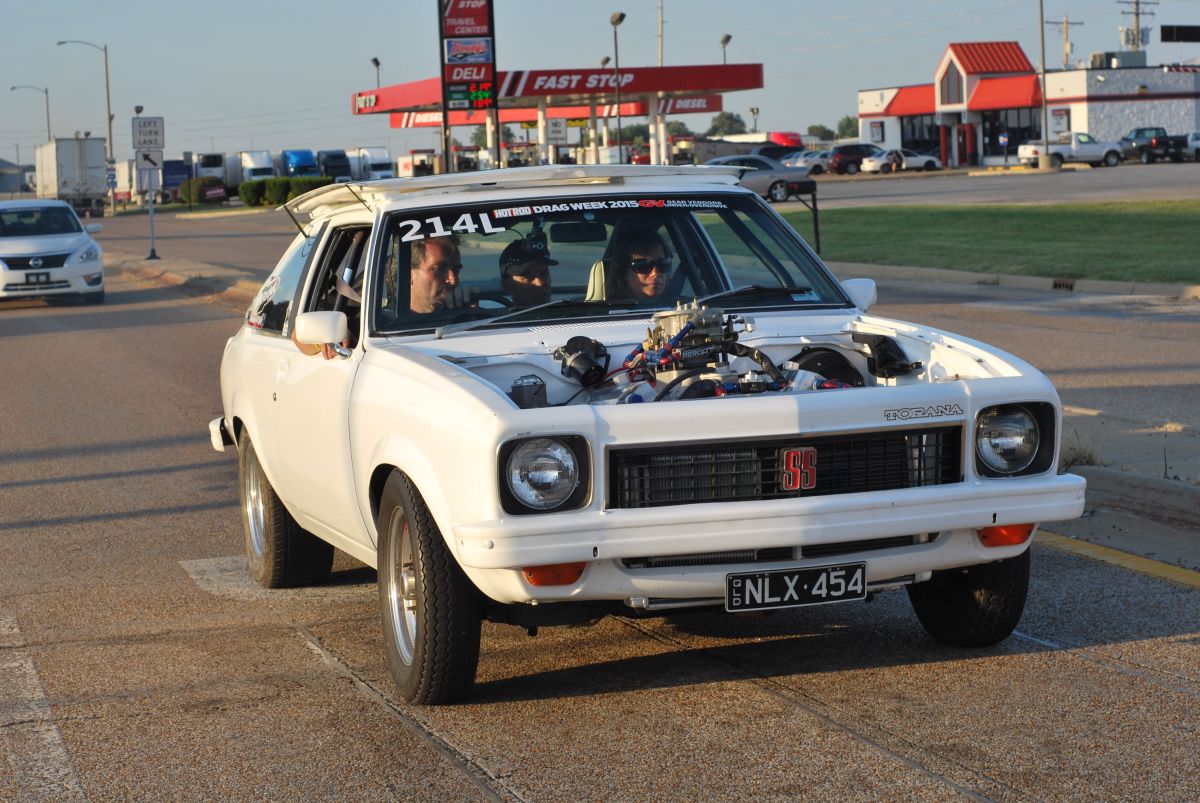
Scott Miller’s ‘68 Cougar quickened its pace throughout Drag Week 2015, running a best time of 9.341 to finish second in the class and could be the rabbit here. Brian Jensen’s ‘77 Holden Torana (above), shipped from Australia, hopes to improve on his third in class with his own week of 9-second passes. As with the Super Street version of this category, this is where a ton of classic muscle will race; Jensen’s Torana is the newest car that will run in the class.
STREET RACE SMALL BLOCK POWER ADDER (M)
Both of the Street Race Small Block classes will be super competitive, just as they were last year. Chris Bishir won the class with an 8.6082-second average on an 8.50 class index and you should expect a similar outcome from him. Bishir and his trusty, unassuming Chevy S10 are fresh off a True Street win at Holley LS Fest less than 48 hours before he’ll make his first pass at Drag Week. James Bailey (‘97 Mustang), Rick Anderson (‘79 Mustang), John Dodson (‘80 Malibu), and Ralph Hoke (‘68 Nova) all have run 8.6-second passes at Drag Week and will certainly be in the mix.
Alexa Taylor (‘68 Camaro), Scott Klepinger (‘86 Camaro), Jason Doisher (‘84 Mercury Marquis Wagon), and Jon Huber (‘79 Mustang) are all 9.0-second cars to boot. Three-time NHRA Top Fuel Dragster champion Larry Dixon is also registered in this class with his ‘66 Chevy II just to make things more exciting. We could go deeper into this class, but with at least 49 entries expected, it might take a while.
STREET RACE SMALL BLOCK NATURALLY ASPIRATED (N)
Just two years ago, this class had only seen seven total passes under 10 seconds in 10 years of competition. Last year, Street Race Small Block Naturally Aspirated got fast in a hurry with six cars averaging 9 seconds. Danny Roberts won the class with his ‘80 Malibu on a 9.6078-second average, which put him just 0.015 second clear of Jason Tabscott’s high-revving, hard-launching ‘75 Camaro at the end of the week. The two dueled all week, hotlapping their cars late in the day to chase hundredths of a second. Unfortunately, Tabscott’s Camaro was stolen just hours after finishing second place last year. In what could be one of the best stories of Drag Week 2016, Tabscott returns with a ‘70 Camaro to square off with Roberts again this year.
Glen Sheeley’s C6 Corvette has finished as high as second and despite pulling off a 9.9028-second average in 2015, he only finished sixth in the class. Add Kevin Studaker’s “Wagon of Doom” to the list of proven 9-second cars in this class; Studaker won the first Drag weekend with his ‘72 Chevy Concours Wagon, making a best time of 9.865 seconds. There are 13 first-timers registered in this class, too, and with Tabscott having been a rookie last year, you can expect to find a new car or two in the 9s.
GASSER A (O)
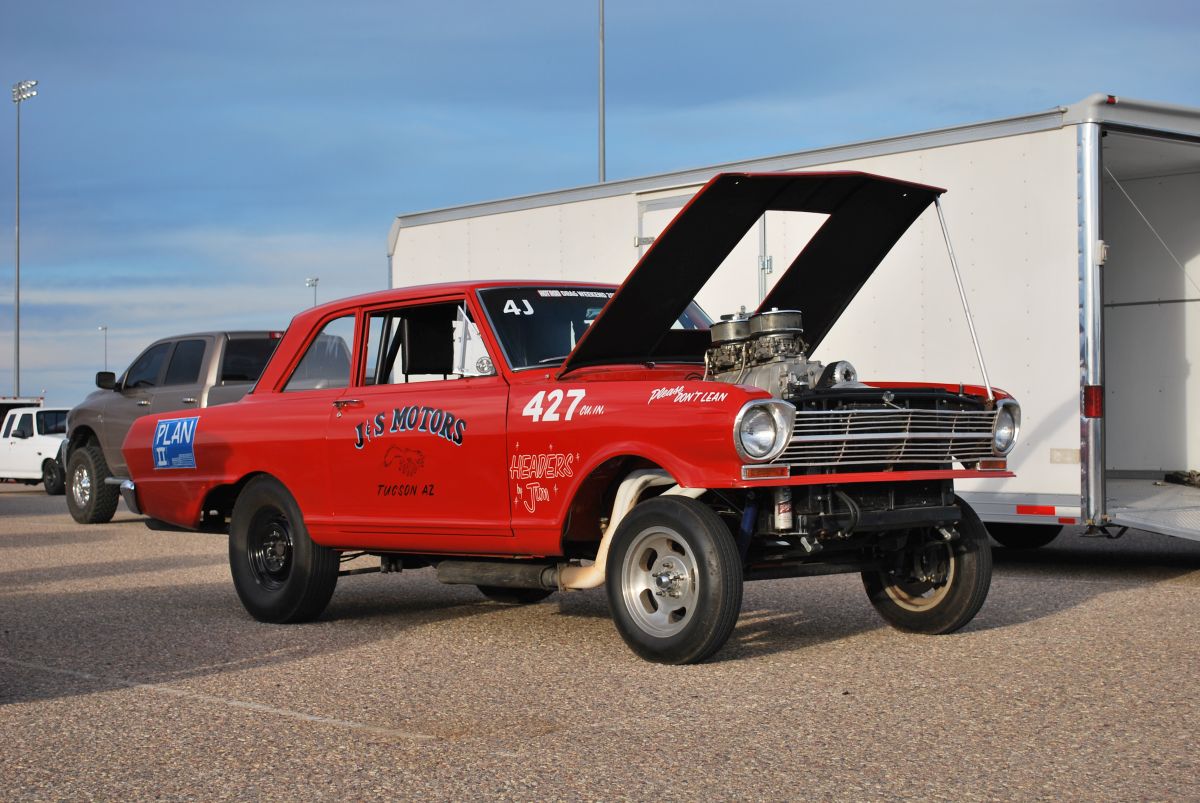
The Gasser and Altered/FX classes represents the great style of early straight-axle race cars from the 1960s. The Gasser A class allows fiberglass bodies with allowance for 8-71 superchargers while the Gasser B must be more traditional A/FX style and naturally aspirated. Jim Forbes’ blown Chevy II (above) is having a pretty decent year, winning Drag Week in Gasser A last year, winning the Gasser category in both Drag Weekends, and also appearing on the cover of Hot Rod Magazine. His low-10s Chevy was quick enough to hold off Jay Grabiak’s ‘55 Chevy Sedan, which averaged 10.8418 seconds last year.
GASSER B (P)
The ‘55 Chevy 210 of Daniel Chisholm and Ken Stasiak won the Gasser B class last year. Their bitchin’ black Gasser is a fan favorite for wheelstands and its ability to run deep into the 9s. They’ll square off with the other favorite in this class, Mike Cox’s ‘53 Ford Customline. Both are 9-second cars—Yes, they are quicker than the blown-and-fiberglass Gassers—and we’ll also be interested to see what Kip Galloway’s High Life, golden-sparkle Falcon can do after running 10.946 seconds last year on the first day but breaking on the road.
HOT ROD (Q)
The Hot Rod class is for pre-1948 cars with displacement capped at 555 cubic inches and no EFI allowed. Last year saw an epic battle in the class between Thomas Ciancitto’s ‘37 Ford Pickup and Tim Hall’s ‘47 International KB-1. The two traded the lead and the class record at least a half-dozen times throughout the week with Ciancitto eventually topping Hall by 0.0114 second over the course of the week. Both will return this year and with Ciancitto setting the best class time of 10.090 seconds, it seems plausible to see these old classic-style rods in the 9s.
Six-time Drag Weeker Keith Harrison brought a ‘34 Ford to its first outing last year and despite still shaking down his Ford at the track, Harrison was running mid-10s by the week’s end. Don’t count him out if he can keep from blowing his own doors off again.
STREET MACHINE ELIMINATOR (R)
The Class Formerly Known As Daily Driver is essentially the Unlimited class in that it does not matter what your car is, it just cannot go quicker than 10.0 seconds. At the end of the week, the 32 quickest cars get put on a ladder and run in a bracket race. There’s really way too much to cover here, but last year’s cutoff for that bracket ladder was an average of 11.5452 seconds. With 16 cars entered in SME that have run under 11 seconds, with the always-quickening field in any class, and with a number of quick new cars on the entry list, we’d expect the bracket cutoff to be even lower, maybe around 11.20.
Resources Guide
Drag Weeks Locations and Dates
Motor Trend YouTube Channel (i.e. Streaming webcast coverage)


Guessing the garage isnt gettting cleaned out this week.
Turns out Mike Roy didn’t sell his Monte Carlo and he’s there. So that’s gonna make Pro Street PA even wilder.
Can’t wait for the action to start, stuck at work now.