

















(By Loren Krussow) – The relentless and expensive pursuit of a slightly-lower ET or a few more miles-per-hour in our cars could seem ironic, given that for the price of a commercial airline ticket to anywhere, we can ride through the sky in an amazingly high tech aluminum-and-titanium marvel at 8/10s the speed of sound. Why dream of 200 in a hot rod when so much faster is only an airport-shuttle trip away?
That being said, stepping down from an antiseptic glass terminal, through a carpeted tube, and into a row of fabric bus seats does little for the gearhead soul. There’s nothing to see beyond a quick glance into the cockpit as you shuffle by, nothing to touch except fold-down trays and the lavatory faucets. The feeling of power and control as you lift off the ground toward the clouds is unmatched but no one in the seats around you cares for much beyond the commodity of trading departure point for destination. The modern airliner is indeed a pinnacle of technology, craftsmanship, and raw chest-rattling thrust, but the experience of it is insulated at best. We will be keeping our hot rods, thank-you.
But we are here to tell you that there is a better way for a car guy to check out a 580-mph jetliner and that’s BangShift.com style. Down, dirty and on the floor. Thanks to BangShift forum member L98Camino (Dan) we have done this.
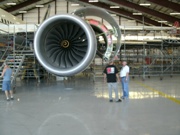
Start by picturing a garage like your own, with toolboxes and shelves and mechanical parts much in evidence. There are a couple of loose engines lying around on stands. A single vehicle in the center has open doors and panels revealing the mechanics inside. However, this garage, unlike ours, is huge and spotlessly clean. Those spare engines make horsepower in the thousands. And the very-swoopy ride inside is the 4th Boeing 787 Dreamliner ever built. It is a development/test aircraft helping to certify the latest design in the long line of Boeing commercial aircraft. It costs close to a billion dollars.
This machine doesn’t look like what you’d see from an airline terminal, not from this angle. In here and up close it’s an animal. The fuselage stretches over your head, approaching 200 feet in length, the tail rises stories above. The wings angle up, back and out for 75 feet to curve at the tips. The enormous Rolls-Royce engines, one under each wing, show long, curved turbine blades and could swallow a boat. Covers slid aside reveal exotic-alloy components and structure, and sensors by the dozens. Serrated edges at the exhaust make it look like you’d get bitten if you touched. Open landing gear doors reveal massive titanium framework machined to perfection.
Peering deeper for details, you’ll find the expected and the unfamiliar. There are few hydraulic lines or servos as most functions are electric now. Looking under insulation and panels for aluminum you’ll see carbon-fiber instead. The cockpit is an array of LCD panels at the head of a complex electronics system that controls every aspect of flight and operation. There’s plenty more of interest in this one-of-six test plane; miles-long bundles of colored wire run out to sensors at every location and back to rows of what look like computer mainframes in the interior, some with seats and display panels behind them. There’s no room for passenger seats, and no textured-plastic panels! Water tanks are mounted for ballast and have heaters to help stress-test the electric system. In and out there are fixtures, sensors and wires for the purpose of testing and re-testing every small thing before certification for this new type is achieved and production deliveries can begin. A few tech people stand on scaffolding under the wing, examining this-and-that. I suppose for these guys it’s all routine but for us, we were blown away. The sheer amount of systems and devices working together towards absolute reliability is beyond comprehension.
Dan, our guide, explains the systems and functions, and if asked, the reasoning behind them. We talk about ground-breaking features such as active gust-alleviation for turbulence control, enmeshed copper fabric in the composite structure for lightning strikes, and how the old engine “bleed-air” method for cabin and de-icing heat is now eliminated. We also discuss the difficult environment this plane is being produced in; economically, politically, and in the corporate sense. Major and minor components come from all over the earth from experienced vendors and those less-so. Commercial delivery has been pushed back again and again. It makes the “old days” of the previous 7-hundred series jets seem like simple times.
In all we had about an hour to circle the aircraft, in-out-and under, and it was an experience we will never forget. Our thanks to Dan, and to everyone working at the California facility where we were able to tour this test-and-development version of a latest cutting-edge design.
Now, Dan…when are you putting a five-speed in that ’67 truck, and why don’t you want to talk about the El Camino? Anyhow, we owe you a beer! Maybe a couple cases…
Click here to see a gallery of Loren’s photos from his tour of the Boeing 787 Dreamliner