






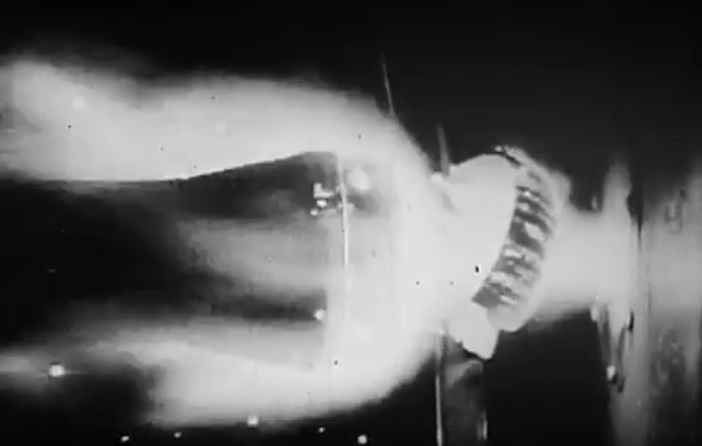
If hot rodding is ultimately about solving problems and achieving new things, there has never been a better or more important group of hot rodders than the NASA engineers of the 1960s that drove the space program to its ultimate success by the end of the decade. They did it with virtually none of the tools people rely on today and had to use immense smarts, empirical thinking, and creative testing to determine if their theories and ideas would actually work. Today, powerful computer modeling can do the work of risky tests but back then there wasn’t near enough computing horsepower to do such things that is why things like Project FIRE existed. This awesomely named project concentrated on how to design and equip the reentry vehicle so that the guys inside would not cook to death, literally.
As mentioned above, today’s testing of such a vehicle would be accomplished by computer modeling. Back in 1965? Eff that. These guys went to wind tunnels that they essentially turned into blast furnaces to literally bathe their models and test materials in the hottest fire they could produce. After they gleaned what they could from that operation, they really kicked it into high gear. How did they do that? In the most 1960s way possible. They shot stuff into space.
After creating a scale model of the reentry vehicle and loading into an Atlas rocket, they fired the whole works into space. Once it reached the altitude that they wanted (sub-orbital but outside the atmosphere) the scale model was released with a twist. To accelerate the model to the right speeds, there was a rocket attached to it that literally shot it back towards the Earth at huge velocity if you consider 25,000mph huge velocity and we do.
As it was hurtling toward Earth the model was sending information to ships, ground stations, and aircraft about the heat it was experiencing. The end result was the knowledge that vehicles could be built to protect human beings reentering Earth’s atmosphere and we have no doubt that work began on such stuff immediately after the FIRE findings were shared. Modern space travel has had its fair share of reentry tragedies, proving the risks (even today) of slipping the “surly bonds of earth” as John Magee wrote nearly a 75 years ago now.


beryllium (toxic metal) was used early on. later replaced with ablative materials which shed particles of materials during re-entry, the particles of which took a lot of the heat generated by air friction with them..pretty neat trick. like a total loss cooling system. Astronauts made many comment about bits and pieces of spacecraft in the trailing stream of hot plasma that they could see out the windows during entry. Best advice from ground control engineers was \”don\’t look\”. HA!