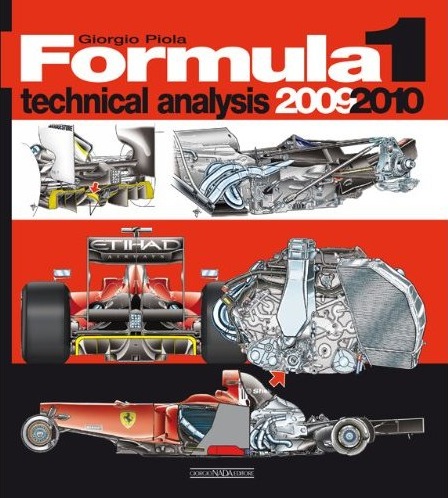













Formula One racing is recognized as the most advanced form of racing in the world. The amount of technology packed into the cars on the track rivals and sometimes exceeds the stuff found in the space craft of some nations! Being very casual fans, we thought we knew a least a little about the cars, but after reading this book, we didn’t know jack! Filled with beautifully detailed cut away drawings and great explanations of technical information, this book is a great read for any gearhead or techno-freak.
The author, Giorgio Piola has been offering these books up since the 1994 season and with each year refines his approach. Broken down into different sections, the cars are systematically broken down by engine, tires and brakes, cockpits (including the steering wheels that have functions to control everything but the weather), suspension, and aerodynamic aids.
Following those sections, each individual team is reviewed. One of their cars is shown in total breakout detail, while the rest of the fleet is pictured but not given the fine tooth comb treatment.
We think this book is doubly interesting because it would hit both the die hard, watch-every-race fan, and the people like us who loosely follow the series right between the eyes. In fact, now that we’ve learned more, and actually have a clue as to what we’re looking at, we’re far more apt to spend some time following the action.
There were a multitude of things that really surprised us about the cars themselves, mainly that they all actually look different. Sounds awful to say but until we looked at all the detail sketches we saw them as near copies of one another. Such isn’t the case with all the cars having slightly different wings, scoops, and design elements. We didn’t know that teams were allowed to use eight engines in one season, that’s it. With the RPM levels approaching 20,000 in these machines, it is even more amazing that a scant eight motors get them through the year of competition. We learned lots about the KERS system, and the fact that each team developed their own. we incorrectly believed it was a standardized system given to all the teams to install.
We cam away from this one a little stunned and slightly red in the face due to the fact that our opinion of what we knew was far more inflated than what we actually did know.
If you are a Formula One freak, buy this book. If you are someone who loves to learn about the bleeding edge of automotive technology, you too need to put this one on your shelf. We give Formula One Technical Analysis 2009/2010 by Giorgio Piola two BangShift thumbs up for the illustrations, education, and style that it is written in.
You can score this book by clicking here!